
If you've noticed more paddles in the air and higher final prices at Ohio sheriff sales lately, you're not imagining it. Franklin County's average winning bid now lands 33% above the opening bid — up from 21% just a year ago. The competition is real, it's funded, and it's coming from buyers who may never set foot in Ohio.
But here's the thing: institutional capital has blind spots. And individual investors who understand those blind spots can still build profitable portfolios at auction.
The online-only catalyst
Ohio House Bill 390 changed the game. The legislation moved all county sheriff sales onto RealAuction's online platform, eliminating the requirement to bid in person at the courthouse steps. For decades, geography was a natural filter — you had to physically show up in each county to participate. That barrier is gone.
Now, a fund manager in Miami or a buying desk in Phoenix can bid on properties in Cuyahoga, Franklin, and Hamilton counties simultaneously without booking a single flight. Every one of Ohio's 88 counties is accessible from a laptop, and institutional buyers noticed immediately.
The shift didn't just open the door to out-of-state capital. It created a single, searchable marketplace where algorithms can scan every listing, compare opening bids against automated valuations, and place bids at scale. What used to require boots on the ground now requires a login and a wire transfer.
The numbers don't lie
Ohio ranks seventh nationally in foreclosure activity, with 3,396 distressed property sales representing 3.30% of all transactions statewide. That volume attracts institutional attention — funds need scale, and Ohio delivers it.
Franklin County tells the sharpest story. In Q1 2025, winning bids averaged 21% above opening bid prices. By Q1 2026, that premium hit 33%. A property with a $100,000 opening bid that would have sold for $121,000 last year now closes at $133,000. That $12,000 difference eats directly into investor margins.
The premium increase correlates directly with the online transition. More bidders per property means more competitive auctions, and the data shows it's not slowing down.
Who are the institutional buyers
Three forces are converging on Ohio sheriff sale competition in 2026.
First, Auction.com is launching a hybrid online and in-person simulcast for Franklin County in Q2 2026. This platform already dominates institutional foreclosure buying nationally, and the simulcast model brings their network of funded buyers into direct competition with local investors.
Second, PropStream added Franklin County sheriff sale calendar integration in February 2026. The result: a 40% surge in investor traffic to Franklin County listings. PropStream's user base skews toward experienced, capitalized investors who run acquisition criteria across multiple markets. More eyeballs on Ohio listings means more bids.
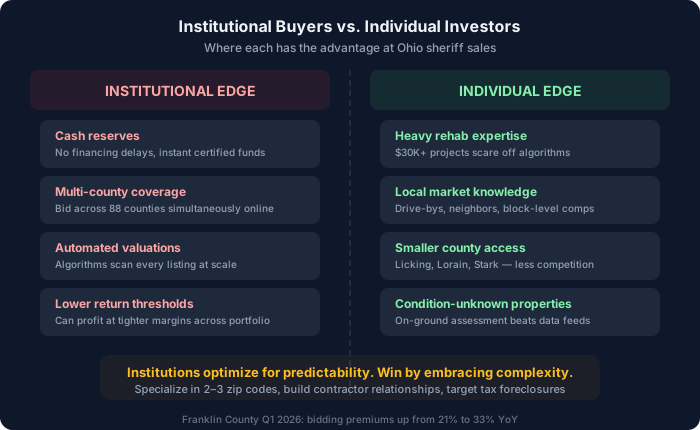
Third, the cash-only requirement at Ohio sheriff sales naturally favors institutional buyers. When you need certified funds on auction day — no financing contingencies, no inspection periods — organizations with dedicated capital reserves have a structural advantage over individuals arranging hard money loans or tapping HELOCs.
These buyers typically target properties with clear title, vacant possession, and rehab budgets under $30,000. They want turnkey rental conversions or quick flips with predictable scopes of work.
Where institutions won't go
Institutional buying algorithms optimize for predictability. They need clean data inputs: accurate ARVs, reliable rehab estimates, clear occupancy status, and title without complications. When any of those inputs get messy, the algorithm passes.
This creates real opportunity in several categories:
Properties needing $30,000 or more in rehab. BiggerPockets investors consistently report that specializing in heavier renovation projects — gut rehabs, structural work, full mechanical replacement — keeps them below the institutional radar. Funds avoid these because the variance in rehab costs makes underwriting unreliable at scale.
Condition-unknown properties. When interior access isn't available before auction, institutional buyers discount heavily or skip entirely. Local investors who can assess exterior condition, talk to neighbors, and estimate scope from experience hold a genuine edge.
Occupancy complications. Properties with tenants, owner-occupants facing eviction timelines, or unclear occupancy status add legal and timeline risk that institutions avoid.
Smaller counties. While Franklin, Cuyahoga, and Hamilton counties attract institutional volume, Ohio's smaller counties — think Licking, Lorain, Stark — see far less competition. The deal sizes are smaller, but the margins can be larger.
Your competitive playbook
Competing against institutional capital doesn't require matching their resources. It requires playing a different game.
Specialize in two to three zip codes. Institutions spread wide. You go deep. Know every street, every comparable sale, every rental rate in your target area. When a property hits the auction calendar, you should already know what it's worth and what it needs before you pull the listing sheet.
Build contractor relationships now. Your ability to get accurate rehab estimates — and actually execute renovations on budget — is a competitive moat. Institutions outsource to project management companies with overhead. A direct relationship with a reliable crew means tighter numbers and faster turns.
Set up early listing alerts. The earlier you identify a property entering the sheriff sale pipeline, the more time you have to research it. AuctionScout sends alerts when new properties hit the calendar, giving you a head start on due diligence while institutional algorithms wait for complete listing data.
Target tax foreclosures. Here's a structural advantage most investors overlook: in tax foreclosure sales, the minimum bid equals only the taxes owed — not the standard two-thirds of appraised value used in mortgage foreclosures. These properties often sell at deeper discounts, and the smaller dollar amounts keep institutional buyers away.
Underwrite at 70% ARV minus repairs. This isn't new advice, but discipline matters more when premiums are rising. If the numbers don't work at 70% of after-repair value minus your rehab estimate, walk away. There will be another auction next month. Institutions can afford to overpay on individual properties because they optimize across a portfolio. You can't.
The local knowledge advantage
Institutional buyers make decisions based on data feeds: automated valuations, tax records, satellite imagery, and comparable sales algorithms. That data is powerful but incomplete.
You can drive the block. You can check the county's code violation database. You can knock on a neighbor's door and learn that the basement floods every spring or that the property next door just sold to a developer. You can attend the county auditor's office and review the full property file.
None of that shows up in a data feed. And all of it affects whether a property is a good investment.
The Ohio sheriff sale competition in 2026 is real, and it's going to intensify as more platforms bring more capital into the market. But competition doesn't eliminate opportunity — it reshapes it. The investors who thrive will be the ones who know their markets deeply, move quickly on the right properties, and let the overpriced ones go to the algorithms.
Get ahead of the competition
AuctionScout gives individual investors the same early access and analysis tools that institutions use — without the overhead. Get AI-powered ARV estimates, investment analysis, and early sheriff sale alerts for your target counties.
Start your free trial of AuctionScout and find your next deal before the institutions do.