
Updated October 2026 with AuctionScout data through September 2026.
Foreclosure activity in Ohio has been rising. If you're investing in Ohio distressed real estate, the ohio sheriff sale vs reo decision isn't theoretical. It's the first fork in the road that determines your deal economics, your risk profile, and how fast you can deploy capital.
We track sheriff sales across Ohio. The honest answer on sheriff sales vs. REOs: neither is universally better. Sheriff sales offer deeper discounts with higher risk. REOs offer cleaner transactions at higher prices. The right choice depends on your capital, your experience, and your tolerance for uncertainty.
Here's the full comparison so you can decide for yourself.
What Is an Ohio Sheriff Sale?
A sheriff sale is a court-ordered auction of a foreclosed property. Ohio is a judicial foreclosure state, which means every foreclosure goes through the courts. A lender files a lawsuit, gets a judgment, and the county sheriff auctions the property to the highest bidder.
The process from filing to auction typically takes 6 to 18 months. Ohio law (ORC 2329.153) mandates a statewide online auction system, and most counties now run their sales through the official sheriff sale website operated by RealAuction. Some smaller counties are still transitioning to the online system.
Key mechanics:
- The minimum bid on the first sale is two-thirds of the appraised value (ORC 2329.20). If the property doesn't sell, the second sale has no minimum bid
- You need a deposit on auction day: $2,000 for properties appraised at $10,000 or less, $5,000 for $10,001 to $200,000, or $10,000 for properties over $200,000 (per ORC 2329.211)
- The remaining balance is due within 30 days
- Properties are sold "as is" with no interior inspection
- You receive a sheriff's deed after payment is completed
The buyer pool at Ohio sheriff sales skews toward experienced investors and, increasingly, institutional buyers. Competition varies dramatically by county and property type.
What Is an REO Property?
REO stands for "real estate owned." It's a property that went through foreclosure, failed to sell at auction (or the bank was the winning bidder), and is now owned by the lender. The bank then lists it for sale, typically through a real estate agent on the MLS or through platforms like Auction.com and Hubzu.
By the time a property becomes REO, the bank has already completed the foreclosure process, cleared the title, evicted any occupants, and sometimes done basic cleanup or winterization. You're buying from a motivated seller (banks don't want to hold real estate), but through a more conventional transaction process.
REO inventory comes straight out of the foreclosure pipeline, so when foreclosures rise, more bank-owned listings follow.
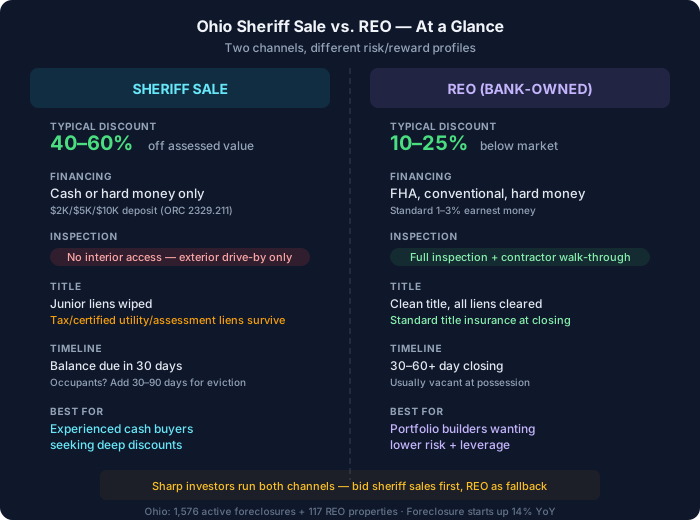
Side-by-Side Comparison
| Factor | Sheriff Sale | REO (Bank-Owned) |
|---|---|---|
| Typical Discount | Median sale 26 to 36% below est. market value (Franklin, Montgomery, Cuyahoga; 12 months to Sep 2026) | 10 to 25% below market |
| Financing | Cash or hard money only | FHA, conventional, hard money |
| Interior Inspection | No access before purchase | Full inspection allowed |
| Title | Junior liens wiped; tax/certified utility/assessment liens survive | Clean title, all liens cleared |
| Title Insurance | Available if title search is clean; may need quiet title action | Standard at closing |
| Occupancy | May have occupants | Typically vacant |
| Competition | Fewer bidders (institutional presence growing) | MLS competition from retail buyers |
| Deposit | $2,000 / $5,000 / $10,000 by appraisal tier | Earnest money (1 to 3%) |
| Balance Due | Within 30 days | 30 to 60+ day closing |
| Where to Find | AuctionScout (tracking/analysis), RealAuction (bidding) | MLS, Auction.com, Hubzu |
| Best For | Experienced cash buyers seeking deep discounts | Investors wanting lower risk and financing options |
Now let's unpack each of these factors.
Price
Sheriff sales are where the deep discounts live. Over the 12 months to September 2026, the median sheriff sale went 26.4% below est. market value in Franklin County (Columbus; 256 sales with an eligible estimate), 32.5% in Montgomery County (Dayton; 145) and 36.0% in Cuyahoga County (Cleveland; 938), as of October 2026.
REO properties are priced closer to market. Banks hire brokers, run CMAs, and list on MLS. You might see 10 to 25% below comparable sales, but you're rarely getting 50 cents on the dollar.
The catch: that sheriff sale discount often reflects risk you're absorbing. No inspection access, potential surviving liens, possible occupants. The discount isn't free money. It's compensation for uncertainty. A sheriff sale at 45% of assessed value with $40,000 in surprise repairs and a $12,000 water lien isn't necessarily better than an REO at 80% of market with a clear scope of work.
Financing
Ohio sheriff sales require cash or hard money. Per ORC 2329.211, your deposit on auction day is $2,000 for properties appraised at $10,000 or less, $5,000 for properties appraised between $10,001 and $200,000, or $10,000 for properties appraised over $200,000. The remaining balance is due within 30 days. No appraisal contingency. No financing contingency. You bid, you win, you pay.
Hard money lenders who work Ohio auctions exist, but expect 12 to 15% interest rates and 2 to 4 points. Your holding costs start climbing from day one.
REO properties open up conventional financing. FHA loans (if you're owner-occupying or the property qualifies), conventional investment property loans (20 to 25% down), even renovation loans like FHA 203(k). This changes the math significantly.
An investor with $100,000 in capital might buy one sheriff sale property outright or put 25% down on three or four REO properties. The leverage math favors REO for portfolio builders. The per-deal margin math often favors sheriff sales.
Inspection and Due Diligence
Sheriff sales offer zero interior access. You're buying based on exterior drive-bys, county records, comparable sales data, and whatever you can piece together. You cannot legally enter the property before purchase.
That means your renovation estimate is a range, not a number. Best case: cosmetic work. Worst case: black mold, cracked foundation, or knob-and-tube wiring you discover after closing. A rehab budgeted as cosmetic can turn into a gut job.
REO properties let you do full due diligence. Schedule an inspection. Bring your contractor. Get actual bids for the work. Walk every room, check the mechanicals, scope the sewer line. Banks sell REOs "as is" too, but "as is with full inspection access" is a fundamentally different risk profile than "as is with zero access."
For buy-and-hold investors running rental portfolios, inspection access alone can justify paying the REO premium. One catastrophic surprise repair on a sheriff sale property can wipe out a year of cash flow across your entire portfolio.
Title and Liens
This is the factor that separates experienced Ohio auction investors from everyone else.
Sheriff sales in Ohio go through judicial foreclosure, which means the court order extinguishes the foreclosing lien and all junior liens (second mortgages, judgment liens, mechanic's liens filed after the mortgage), provided those lienholders were properly named as parties in the foreclosure action. The judicial process provides significantly cleaner title than non-judicial foreclosure states.
However, certain liens survive the sale and transfer to the buyer:
- Property tax liens (ORC 5721.10: always first priority, always survive)
- Special assessments certified to the county auditor (street improvements, sewer projects)
- Water and sewer charges certified to the county auditor (ORC 743.04, 729.49)
- Municipal code violation and demolition liens certified to the tax duplicate
- Federal tax liens (IRS retains a 120-day right of redemption even if properly named)
Always check the county treasurer's website for outstanding tax balances and certified assessments before bidding.
In Cuyahoga County, back taxes and water liens on distressed Cleveland properties can be large relative to the house's value. These costs transfer to you.
And if a second mortgage is the foreclosing party (not the first), the first mortgage survives. You'd be buying the property subject to the existing first mortgage balance. This is the single most expensive mistake in Ohio sheriff sale investing.
REO properties come with clean title. The bank has already gone through foreclosure, cleared all liens (including the government and utility liens that survive sheriff sales), and can deliver marketable title with standard title insurance at closing.
For investors who don't have a title research workflow dialed in, this difference alone might tip the scales toward REO.
Timeline
Sheriff sales: Win the auction, pay the balance within 30 days, sheriff's deed is recorded. If the property is vacant, you can start work almost immediately. If it's occupied, add 30 to 90 days for eviction proceedings through the courts. Some investors offer "cash for keys" to speed up voluntary departure.
REO: Offers go through the bank's asset manager, sometimes through multiple approval layers. Counter-offers can take weeks. Closing typically takes 30 to 60 days, sometimes longer. But the property is usually vacant and you get possession at closing.

When Sheriff Sales Win
Sheriff sales are your play when:
- You have cash or reliable hard money and can move fast
- You can absorb a worst-case rehab scenario without going underwater
- You have a title search process you trust (an attorney or title company experienced with Ohio foreclosure)
- You're targeting deep discounts in counties you know well
- You have rehab crews ready to mobilize quickly
- Your exit strategy (flip or BRRRR refinance) depends on buying well below market value
The math works best on properties where the discount is large enough to cover your worst-case scenario. If a property is assessed at $120,000 and you can buy it at sheriff sale for $55,000, you have $65,000 of cushion. Even a bad rehab surprise and some surviving liens still leave room for profit.
When REO Wins
REO is your play when:
- You want to use conventional financing and preserve capital for multiple deals
- You're building a rental portfolio and need predictable rehab costs
- You're newer to foreclosure investing and want full due diligence
- You want clean title without the research burden and risk
- You're in markets where institutional buyers have driven up sheriff sale prices
- The price gap between sheriff sale and REO is small enough that the risk premium isn't worth it
REO also wins when you factor in opportunity cost. The weeks of title research, utility verification, and court record analysis required for sheriff sale due diligence is time you could spend finding and closing REO deals. If your hourly value is high and your deal flow is strong, the cleaner REO process might produce better returns on your time even at higher purchase prices.
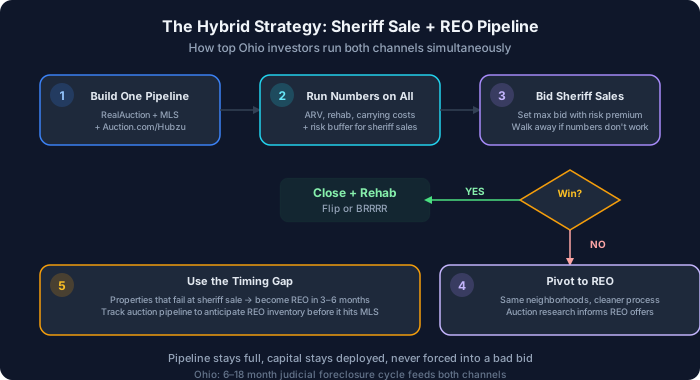
The Hybrid Strategy Ohio Investors Are Using
The sharpest Ohio investors aren't choosing one channel over the other. They're running both simultaneously. Bid at sheriff sale first. Buy REO as the fallback.
Here's how it works:
Step 1: Build one pipeline across both channels. Use AuctionScout for sheriff sale listings across Ohio with AI-scored deal analysis and daily updates. Use MLS and Auction.com/Hubzu for REOs.
Step 2: Run your numbers on every property regardless of channel. ARV, rehab estimate, carrying costs, exit strategy. For sheriff sales, add a risk buffer for unknown condition and surviving liens. For REOs, factor in the higher purchase price but tighter cost projections.
Step 3: Bid at sheriff sales where the numbers work. Set your max bid to account for the zero-inspection risk premium. If you win at a price that works, great. If you don't, you haven't lost anything.
Step 4: Pivot to REO when sheriff sales don't pan out. When you don't win at auction, or when title research reveals deal-breaking liens, shift to REO opportunities in the same neighborhoods. Your sheriff sale research gives you negotiation intelligence. If you know properties in a neighborhood are going for 50 cents on the dollar at auction, that anchors your REO offer.
Step 5: Use the timing gap. Ohio's judicial process means REO inventory lags auction activity by several months. Properties that fail to sell at sheriff sale today become REO listings in three to six months. If you're tracking the auction pipeline, you can anticipate REO inventory before it hits the market.
The hybrid approach keeps your pipeline full and your capital deployed. It also means you're never forced into a bad sheriff sale bid because it's the only deal in front of you.
How to Research Both Channels Efficiently
For Sheriff Sales
- County auditor and treasurer websites for tax delinquency, assessed value, and special assessments
- Court records (county Common Pleas Court) for the foreclosure case file. Read the court entry ordering the sale. It tells you which lien is foreclosing and what survives.
- Municipal utility departments for water/sewer balances. Call directly. Don't rely on title searches alone for utility liens.
- Drive-by inspection for exterior condition. Bring a contractor if possible.
- AuctionScout for AI price predictions, renovation estimates, and the Deal Analysis tab.
For REO Properties
- MLS comps through your agent or any listing portal for neighborhood pricing
- Professional home inspection ($300 to $500, non-negotiable on investment properties)
- Contractor walk-through for detailed rehab estimates
- Title commitment from the closing company (the bank typically provides this)
- Neighborhood analysis for rental rates (buy-and-hold) or comparable sales (flip)
The research burden is lighter on REOs because the bank has already done the title work. But don't skip the inspection just because the listing says "move-in ready." Banks have different definitions of "ready" than investors do.
Common Mistakes and How to Avoid Them
Comparing sticker prices instead of all-in costs. A $45,000 sheriff sale with $12,000 in surviving liens, $8,000 in unexpected repairs, and $4,000 in hard money interest costs $69,000 all in. Compare that to a $72,000 REO where you know the full scope. The gap might be smaller than you think.
Skipping title research on sheriff sales. It's tempting to get excited about a low bid price and skip the court record review that would reveal a first-mortgage-surviving situation, a $15,000 tax lien, or a lienholder who wasn't named as a party in the foreclosure (whose lien survives the sale). Read the case docket. Check every named defendant. Do the work.
Assuming REO means no negotiation. Banks are motivated sellers. They don't want to hold real estate, pay property taxes, maintain insurance, and deal with maintenance. Low offers get countered, not rejected. Especially in counties with rising REO inventory.
Ignoring the institutional buyer dynamic. Institutional buyers are increasingly active at Ohio sheriff sales, particularly in Franklin County. If your win rate is declining, it might not be your analysis. It might be competition with buyers who have different return thresholds than you do. This is one of the dynamics pushing smaller investors toward REO as an alternative channel.
Not accounting for eviction timelines on sheriff sales. A sheriff sale property with occupants adds 30 to 90 days and $1,000 to $3,000 in legal costs before you can start work. Budget for it. REO properties are almost always vacant.
Using the same max bid formula for both channels. Sheriff sales need a larger contingency buffer (15 to 20% of your rehab estimate) because you can't inspect. REOs can use tighter numbers (5 to 10%) because you can verify condition before closing.
Frequently Asked Questions
Do I need a real estate agent for Ohio sheriff sales?
No. Sheriff sales are handled through the county court system. Bidding is done online through Ohio's official RealAuction platform for most counties. No agent representation needed, and there's no buyer premium. But having a real estate attorney review your title research before bidding is essential. For REO purchases, an agent familiar with bank-owned transactions can help you submit competitive offers and handle the bank's process.
Can I get title insurance on a sheriff sale property?
Yes, in most cases. Because Ohio is a judicial foreclosure state, the court process extinguishes junior liens, and title companies will generally insure a sheriff's deed if a title search confirms all lienholders were properly joined in the foreclosure action. If the title search reveals defects, such as a lienholder who wasn't named as a party, a quiet title action may be needed first (typically $1,500 to $3,000 in attorney fees, 2 to 6 months). If there are IRS tax liens, title companies will typically wait out the 120-day federal redemption period. REO properties come with standard title insurance at closing since the bank has already cleared any title issues.
What happens if a sheriff sale property is occupied?
You become the new owner, but Ohio requires a formal eviction process through the courts. This typically takes 30 to 90 days. Many investors offer "cash for keys" (usually $500 to $2,000) to incentivize voluntary departure. It's often faster and cheaper than formal eviction. REO properties are almost always vacant by the time they're listed.
Which Ohio counties have the most activity right now?
Cuyahoga County (Cleveland) has high volume across both channels. Of the three big metros, Cuyahoga's median sheriff sale also went furthest below est. market value over the 12 months to September 2026 (36.0%), ahead of Montgomery County (Dayton, 32.5%) and Franklin County (Columbus, 26.4%). Check AuctionScout's county recaps for current inventory in your target markets.
Should I start with sheriff sales or REO as a new investor?
REO. The inspection access, clean title, and conventional financing options reduce your risk while you're learning the market. As you build experience, capital, and a network of contractors and attorneys, add sheriff sales to your strategy. The hybrid approach is the eventual goal for most serious Ohio investors.
Pick Your Path, Run the Numbers
Ohio's foreclosure pipeline is growing, and investors who do the math before they bid will be better positioned. Whether you enter through sheriff sales, REOs, or both, the investors who win are the ones who do the math before they place the bid.
AuctionScout tracks sheriff sale listings across Ohio with daily updates, AI price predictions, renovation estimates, and the Deal Analysis tab. Pro is $49/month for the full analytics suite. Try it free for 14 days, no credit card required.
See what's available in Franklin County, Cuyahoga County, or Montgomery County.