
The biggest mistake Ohio sheriff sale investors make isn't overbidding. It's buying a property at auction and then discovering $14,000 in delinquent taxes, $3,200 in water liens, and an HOA balance that's been compounding for three years. All of which are now yours.
Confusion about ohio sheriff sale liens is common among investors. On BiggerPockets, on Reddit, in local REI meetups, "What liens survive?" comes up again and again. And the answers people give each other are often wrong.
Here's the core problem: a sheriff sale wipes out some liens but not others. Knowing the difference is the line between a profitable deal and a financial disaster. This guide breaks down exactly what survives, what gets extinguished, and how to research it all before you ever place a bid.
What You Need to Know First
Before we get into specific lien types, you need to understand how Ohio foreclosures work at a basic level.
Ohio is a judicial foreclosure state. That means a lender files a lawsuit, gets a court judgment, and the court orders the property sold by the county sheriff. This isn't a quick process. It typically takes 6 to 18 months from filing to auction.
You also need to understand lien priority. Think of liens as a stack, ordered by when they were recorded (with some important exceptions). The foreclosing lien and everything below it in the stack gets wiped clean at sale. Everything above it survives and transfers to the buyer.
One more thing: Ohio sheriff sales are "buyer beware" transactions. The court doesn't guarantee clear title. There's no disclosure requirement. There's no return policy. Your research is your only protection.
How the Court Notification Process Works
Because Ohio is a judicial foreclosure state, the court requires the foreclosing party to identify every known lienholder on the property and name them as defendants in the lawsuit. Under ORC 2329.191, the party seeking sale must file title reports listing the name and address of each lienholder. State lienholders, including the county treasurer, must be joined as party defendants under ORC 2329.192.
Every lienholder gets served and has the opportunity to respond to the case and assert their claim. Here's what matters for investors:
- If a lienholder is named and served but doesn't respond, the court can enter a default judgment against them. Their lien is extinguished by the sale, and their interest transfers to the sale proceeds. In other words, ignoring the court notice typically means forfeiting the lien against the property.
- If a lienholder is NOT named at all, their lien survives the sale entirely. The buyer takes the property subject to that omitted lien. This is why reading the foreclosure case file (which lists all named defendants) is one of your most important pre-bid research steps.
- Tax liens are the major exception. Even though the county treasurer is named as a defendant and notified by the court, property tax liens don't get extinguished the way other liens do. Tax liens carry statutory super-priority under ORC 5721.10, and the court is required to deduct taxes from sale proceeds before any other distribution under ORC 323.47. The state's appearance is also presumed for jurisdictional purposes (ORC 2329.192), so the tax lien is protected through multiple independent legal mechanisms.
The bottom line: the court notifies everyone and gives them a chance to protect their lien. Most lienholders who get ignored lose out. But taxes are protected by statute no matter what.
The Basic Rule: What Gets Wiped, What Survives
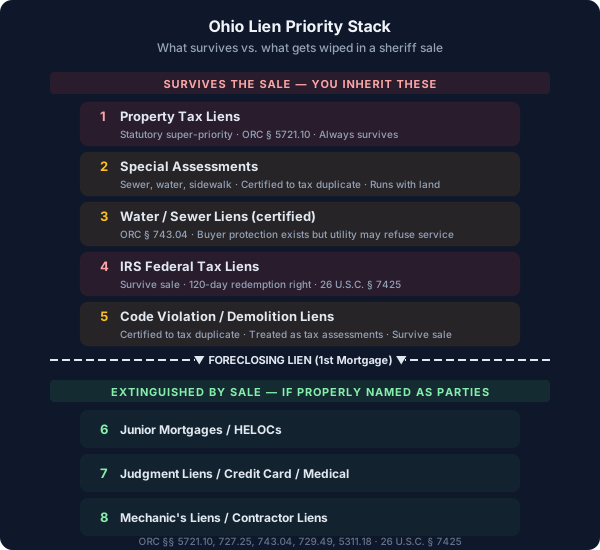
Here's the hierarchy that generally governs Ohio sheriff sales:
- Real property tax liens (statutory super-priority, always survive)
- Special assessments (street improvements, sidewalks, sewer projects)
- Municipal utility liens (water, sewer, certified to auditor, but with buyer protections discussed below)
- First mortgage (usually the foreclosing party)
- Second mortgage / HELOC
- Judgment liens (credit card lawsuits, personal injury, etc.)
- Mechanic's liens (contractor work)
If the first mortgage forecloses, items 1 and 2 survive and transfer to you. Items 5 through 7 get wiped. The first mortgage itself is satisfied by the sale proceeds.
This is the general framework. But the details matter, and they vary by lien type and sometimes by county. Let's walk through each category.
Tax Liens: Statutory Super-Priority
Property tax liens in Ohio sit at the absolute top of the priority stack. Under ORC 5721.10, the state has the "first lien" on any property with delinquent taxes, for the full amount of taxes, assessments, interest, and penalties. This lien is statutory, meaning it doesn't depend on recording date or the county's participation in the foreclosure case. It exists by operation of law.
When a property sells at sheriff sale, ORC 323.47 requires the court to deduct property taxes from the sale proceeds before distributing anything to other lienholders. If the sale proceeds aren't enough to cover the full tax balance, the deficit gets certified back to the county treasurer and continues as a lien on the property. Either way, the new owner is responsible.
This includes:
- County property taxes collected by the county treasurer
- School district taxes (often the largest portion of the tax bill in Ohio)
- Municipal income tax liens tied to the property
- Special assessments for street lighting, sewer improvements, sidewalk repairs, and similar municipal projects
In Franklin County (Columbus), properties can go to sheriff sale with years of delinquent property taxes attached. In Cuyahoga County (Cleveland), combined city and school millage rates can push the total higher, and in places like East Cleveland back taxes can be large relative to the house's value.
Special assessments are the sleeper cost. A property might show current on regular taxes but carry a $6,000 special assessment for a sewer project that won't be paid off for another eight years. That assessment transfers to you. You'll owe the remaining balance plus future annual installments.
How to check: Every Ohio county auditor runs a website where you can look up tax delinquency by parcel number. The county treasurer's site will show you whether a property has been flagged for DTAC (Delinquent Tax and Assessment Collection). Do both searches. A property can appear current on the auditor's site but still have a DTAC balance that hasn't been updated. And call the treasurer's office to confirm. Online portals sometimes lag 30 to 60 days behind actual payments.
Key auditor portals for Ohio's largest counties:
- Cuyahoga County: myplace.cuyahogacounty.us
- Franklin County: property.franklincountyauditor.com
- Hamilton County: wedge.hcauditor.org
- Montgomery County: mcrealestate.org
- Summit County: fiscaloffice.summitoh.net
Utility Liens: Water and Sewer vs. Electric and Gas
This is where it gets messy. Utility lien survival depends on the type of utility, the municipality, and whether charges have been certified to the county auditor.
Water and Sewer: Certified Liens Run With the Property (With a Buyer Protection)
Under ORC 743.04, municipalities can certify unpaid water and sewer bills to the county auditor as liens on the property. Once certified, these charges are placed on the real property tax list and collected the same way as taxes.
Cleveland, Columbus, Cincinnati, Dayton, Toledo, and Akron all certify unpaid water/sewer charges this way. The amounts can be substantial. Cleveland Water Department liens of $3,000 to $8,000 are common on distressed properties. In Columbus, we regularly see water/sewer balances of $2,000 to $5,000 on foreclosed homes.
However, ORC 743.04 also includes a protection specifically for sheriff sale buyers. The statute prohibits certification of water charges from a period prior to a sheriff sale against the new purchaser. If pre-sale charges are improperly certified after the sale, the new owner can provide written notice to the auditor, who must promptly remove them from the tax duplicate. This protection does not apply if the buyer is the prior owner, a family member, or an entity controlled by the prior owner.
In practice, this means the legal risk of inheriting water liens is lower than many investors assume. But there are two important caveats. First, charges that were already certified before the sale may still be in the system. Second, some municipalities won't turn on water service at the property until the prior balance is cleared, regardless of ownership or the statute's protections. So you might not technically owe the debt, but you can't get water turned on until it's paid. Same result, different mechanism. Always call the utility to understand what you're actually facing.
Electric and Gas: Usually Don't Survive
Electric and gas utilities in Ohio (AEP Ohio, Duke Energy, FirstEnergy, Columbia Gas) are typically regulated by the Public Utilities Commission of Ohio. These debts are personal to the account holder, not attached to the property. When ownership changes at sheriff sale, you open a new account in your name and start fresh.
But some municipalities operate their own electric utilities (Cleveland Public Power, Hamilton's municipal electric). Municipal utility debts can be certified against the property the same way water liens are under ORC 743.04. Always call the specific provider for properties you're researching.
How to check: Call the municipal water department for the property's municipality. Give them the address. Ask for the current balance and whether any liens have been certified to the county auditor. For electric and gas, call the provider and ask whether any property-level debt exists. This takes 15 minutes and can save you thousands.
HOA Liens and Assessments
Homeowner association liens follow the general priority rule, and understanding their exact position in the stack matters.
Under ORC 5311.18 (condominiums) and ORC 5312.12 (planned communities), associations have a continuing lien on any unit for unpaid assessments, interest, late fees, collection costs, and attorney's fees.
The priority is defined by statute: the HOA lien is prior to any lien or encumbrance that arises after the HOA lien is filed, except for real estate tax liens and first mortgages. In other words, HOA assessment liens are generally subordinate to both property taxes and first mortgages.
What this means at sheriff sale: if a first mortgage is the foreclosing party, HOA assessment liens are typically extinguished along with other junior liens, because they're subordinate to the first mortgage under the statute. The HOA's interest transfers to the sale proceeds.
There's an important caveat though. If the HOA declaration was recorded before the mortgage being foreclosed (which is common, since declarations are recorded when subdivisions are built), the HOA's continuing lien right has an argument for senior priority based on recording date. This creates an ambiguity that varies by county and sometimes requires legal review.
Also note that Ohio does not currently have an HOA "super-lien" statute that would give associations automatic priority over first mortgages for a set number of months of unpaid assessments. Some other states do, but Ohio has not enacted this. Legislation has been introduced (including HB 572, the "Ohio Community Preservation Act") but has not passed as of this writing.
What does this cost when HOA obligations survive? A Westerville subdivision with $250/month HOA fees and two years of delinquency means $6,000 in back assessments. A condo in Lakewood with $400/month fees and 18 months unpaid runs $7,200. Plus late fees, interest, and the association's legal costs.
And don't forget the ongoing obligation. Once you own the property, you owe all future HOA assessments. If the HOA charges $300/month, that's $3,600 per year added to your carrying costs. Make sure that's in your numbers before you bid.
How to check: Contact the HOA management company and request an estoppel letter or payoff statement. This shows the current balance owed, including fees and legal costs. Also compare the HOA declaration recording date against the foreclosing mortgage recording date at the county recorder's office. If the priority is unclear, consult a foreclosure attorney before bidding.
Junior Liens, Second Mortgages, and Judgment Liens
Good news. When a first mortgage forecloses, all of these junior liens are typically extinguished:
- Second mortgages and HELOCs
- Judgment liens from lawsuits (credit card, medical, personal injury)
- Mechanic's liens from contractors
- Most IRS federal tax liens (but with a catch)
The key word is "junior." These liens only get wiped if they were recorded after the foreclosing lien. And as explained above, the lienholders must be properly named and served in the foreclosure case. If a junior lienholder is omitted from the lawsuit entirely, their lien survives.
Federal Tax Liens: The 120-Day Redemption
IRS liens get special treatment. Under 26 U.S.C. Section 7425, the federal government has a 120-day right of redemption after a sheriff sale. The IRS can step in during that window, pay what you paid at auction, and take the property.
There's also a notice requirement: if a federal tax lien was properly filed more than 30 days before the sale and the IRS was not given adequate notice (at least 25 days before the sale per IRS procedures), the federal lien can survive the sale entirely. Make sure the foreclosing party served the IRS properly by reviewing the case file.
In practice, the IRS rarely exercises its redemption right on residential properties. But "rarely" isn't "never." If you see a federal tax lien on a property, factor the 120-day uncertainty into your timeline and carry costs. You won't want to start a major rehab on a property the IRS might reclaim.
Code Violations and Demolition Liens
One more category investors overlook: municipal code violation fines and demolition liens are typically assessed against the property and survive sheriff sales. A property with an outstanding demolition order can cost $15,000 to $30,000 to address. Check with the municipal building or housing department before bidding.
How to Research Liens Before You Bid
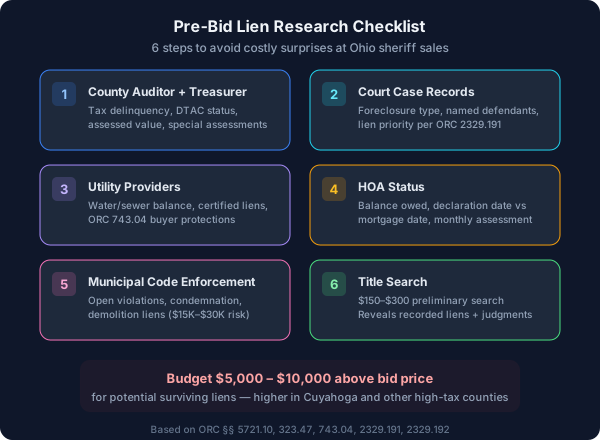
Every dollar spent on pre-bid research protects you from post-purchase surprises. Here's the process we recommend.
Step 1: County Auditor and Treasurer Records
Start at the county auditor's website. Search by parcel number or address. You'll find the assessed value, tax payment history, special assessments, and the property's legal description.
Then check the county treasurer's site separately. The auditor shows the tax rate. The treasurer shows what's actually been paid. Look for DTAC entries, which indicate the county has already started delinquent tax collection.
Step 2: Court Records for the Foreclosure Case
Pull up the case on the county Common Pleas Court website. The case file lists all parties named as defendants, which tells you who the lender believes has a lien. Under ORC 2329.191, the foreclosing party must file title reports identifying all known lienholders. Read the court entry ordering the sale. It often specifies which liens transfer to the buyer and which get extinguished. This is one of the most underused pieces of information available to auction investors.
Pay particular attention to whether all relevant lienholders were actually named. Any lienholder not named in the case retains their lien against the property regardless of priority.
Step 3: Utility Providers
Call the municipal water department and ask about the balance on the property address. Ask specifically whether any charges have been certified to the county auditor. For electric and gas, call the provider and ask whether any property-level debt exists. Budget 15 minutes for these calls.
Step 4: HOA Status
If the property is in a planned community, condo complex, or any HOA-governed neighborhood, contact the management company. Request a balance statement and the current assessment schedule. Also verify whether the HOA declaration was recorded before or after the mortgage being foreclosed.
Step 5: Municipal Code Enforcement
Call the city's building or housing department. Ask if there are any open code violations, condemnation orders, or demolition liens on the property.
Step 6: Title Search (Optional but Recommended)
For properties you're seriously considering, a preliminary title search from a title company runs $150 to $300. It reveals recorded liens, judgments, and encumbrances you might miss with manual research.
AuctionScout pulls together tax data, lien indicators, and property details in one place, so you can flag potential issues during initial screening. It won't replace a title search, but it cuts your research time significantly by surfacing the properties worth investigating further.
Common Mistakes Investors Make
Assuming the sale wipes everything. The number one mistake. Sheriff sales wipe junior liens whose holders were properly named and served. Senior liens survive. If you don't know the priority stack, you're guessing with your capital.
Ignoring water liens. Water and sewer liens are the most frequently overlooked surviving obligation. ORC 743.04 does offer buyer protections against pre-sale charges, but the practical reality (utilities refusing service until the old balance is paid) can cost you regardless. A phone call prevents this. Make the call.
Not reading the court entry. The foreclosure case file tells you exactly what the court is ordering and who was named as a defendant. Under ORC 2329.191, this file must include all known lienholders. Investors who skip this step are flying blind.
Trusting forum advice without verification. We see incorrect lien advice on BiggerPockets and Reddit regularly. Someone posts that "sheriff sales wipe all liens" and it gets upvoted by people who haven't tested that assumption with their own money. Always verify with official county records and the relevant ORC sections.
Forgetting ongoing HOA costs. Even if the back balance is small, monthly HOA assessments compound fast. A $250/month HOA means $3,000/year in carrying costs you need in your pro forma.
Skipping title insurance. After buying at sheriff sale, get an owner's title insurance policy. Most title companies won't insure until the redemption period expires and you've filed a quiet title action (budget $1,500 to $3,000 and three to six months). But do it. It protects you if something surfaces later.
Frequently Asked Questions
Do all liens get wiped in an Ohio sheriff sale?
No. Only liens junior to the foreclosing lien, whose holders were properly named and served in the foreclosure case, get extinguished. Tax liens carry statutory super-priority under ORC 5721.10 and survive regardless. Special assessments, certified utility liens, and certain HOA assessments may also survive depending on their priority position. This is the most misunderstood aspect of Ohio sheriff sales.
What happens to lienholders who are notified by the court but don't respond?
In Ohio's judicial foreclosure process, all known lienholders must be named as defendants and served (ORC 2329.191). A lienholder who is properly named and served but doesn't respond or appear typically has their lien extinguished by the sale. Their interest transfers to the sale proceeds instead. The major exception is tax liens, which are protected by statutory super-priority and survive regardless of the county treasurer's participation in the case.
How do I find out what liens are on a property before the auction?
Start with the county auditor and treasurer websites for tax information, then contact utility providers for water and sewer balances. Review the foreclosure case file, which lists all named lienholders (ORC 2329.191). For thorough coverage, order a preliminary title search. AuctionScout also flags key lien indicators in our property analysis to help with initial screening.
Can I negotiate surviving liens after buying?
Tax liens can't be negotiated down, but you can set up payment plans with the county treasurer. Water liens can occasionally be negotiated with the municipal utility, and ORC 743.04 provides some protection against pre-sale charges being certified against new buyers. HOA balances sometimes have room to negotiate late fees and legal costs if you bring the account current quickly. It's always worth asking.
What happens if I discover a lien after the sale?
You're responsible for it. Ohio sheriff sales are buyer-beware transactions. There's no rescission right, no disclosure obligation, and no recourse against the county. This is exactly why pre-bid research isn't optional.
How much should I budget for potential surviving liens?
There's no universal number, but we recommend budgeting at least $5,000 to $10,000 above your bid price for potential surviving obligations on any Ohio sheriff sale property. For properties in Cuyahoga County or other high-tax jurisdictions, budget higher. Always check the specific tax delinquency and utility balances before bidding to get an accurate number for each property.
Start Researching Before You Bid
The investors who consistently profit at Ohio sheriff sales aren't the most aggressive bidders. They're the ones who spend two hours researching before spending two minutes bidding.
AuctionScout tracks auction listings across Ohio with daily updates, AI price predictions, and the Deal Analysis tab, which shows risk signals on each property. Set up alerts for your target counties and start screening properties before they hit the auction block.
Try AuctionScout free for 14 days, no credit card required. Check out the latest listings in Franklin County, Cuyahoga County, or whichever Ohio market you're watching.